Age of Wonders: Exploring the World of Science Fiction (2nd Edition) by David G. Hartwell
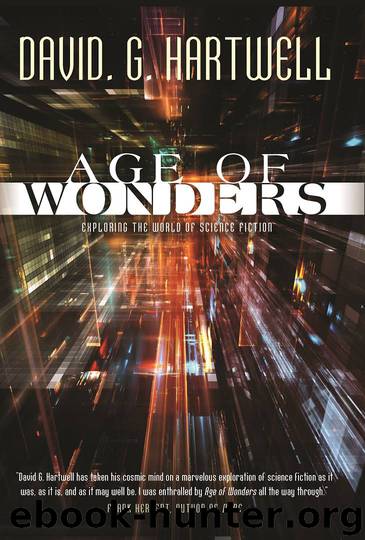
Author:David G. Hartwell [Hartwell, David G.]
Language: eng
Format: epub
Tags: Non-Fiction, Literary Criticism, Science Fiction
ISBN: 978-0-7653-9813-0
Publisher: Tor Books
Published: 2017-01-24T05:00:00+00:00
8
SCIENCE FICTION WRITERS CAN’T WRITE FOR SOUR APPLES
Any bright high school sophomore can identify all the things that are wrong about Van Vogt.… But the challenge to criticism which pretends to do justice to science fiction is to say what is right about him: to identify his mythopoeic power, his ability to evoke primordial images, his gift for redeeming the marvelous in a world in which technology has preempted the province of magic and God is dead.
—Leslie A. Fiedler (from his essay “The Criticism of Science Fiction,” in Coordinates, Carbondale: Southern Illinois University Press, 1983)
ALL THE wonderful ideas, the big hypotheses and powerful images, which so often are the main and abiding appeal in a science fiction story, have had a truly pernicious effect on characterization and style in SF over the decades. Nine times out of ten, the ideas and images have so fascinated the writers and readers that the rich and imaginative settings are inhabited by bloodless or flat stock characters familiar after a hundred years of adventure fiction.
So what? Well, the fashion in fiction that we admire since the middle of the nineteenth century has been that characterization is more and more the central task of the artist in prose fiction. By developing contrary to that fashion, for the most part in cheap commercial magazines and their market, science fiction has allied itself with the aesthetic of naturalistic, journalistic prose and fast-paced commercial storytelling, full of color and plot. The highest goal of the SF writers as a group, at least through the 1950s, was to achieve the slick (versus pulp) style of storytelling, popular from Rudyard Kipling, H. G. Wells, and Jack London up through Dashiell Hammett, F. Scott Fitzgerald, and Ernest Hemingway. And, of course, to sell their stories to magazines such as Collier’s, The Saturday Evening Post, Esquire, and Playboy, for more than the penny or two per word prevalent in SF.
But the short story as a popular and commercial form died out in the U.S. in the 1950s, with the demise of most of the major markets for short fiction. Aside from the SF field, some detective fiction, and a very few organs such as The New Yorker, Playboy, and Esquire, short fiction survives today only as a noncommercial form in the literary magazines, and in small hardcover printings with literary pretensions. SF has survived not by changing so much as by staying mostly pop lit, in its own magazine and anthology ghetto. And of course in transplanted form in the media (where somehow the SF usually gets lost in translation).
One of the reasons that SF is so frequently transplanted off the written page into media presentations is that a mediocre SF story often tells in any form as effectively as it reads on the page (see Chapter 3). Since the standard for publication in the field from Gernsback (who didn’t know English all that well but did know science and technology) through John W. Campbell, even to the present, has been clear
Download
This site does not store any files on its server. We only index and link to content provided by other sites. Please contact the content providers to delete copyright contents if any and email us, we'll remove relevant links or contents immediately.
| Fantasy | Gaming |
| Science Fiction | Writing |
Sita - Warrior of Mithila (Book 2 of the Ram Chandra Series) by Amish(54818)
The Crystal Crypt by Dick Philip K(36832)
Cat's cradle by Kurt Vonnegut(15294)
Always and Forever, Lara Jean by Jenny Han(14868)
Ready Player One by Cline Ernest(14615)
The Last by Hanna Jameson(10224)
Year One by Nora Roberts(9760)
Persepolis Rising by James S. A. Corey(9333)
The remains of the day by Kazuo Ishiguro(8944)
Never let me go by Kazuo Ishiguro(8846)
Red Rising by Pierce Brown(8730)
Dark Space: The Second Trilogy (Books 4-6) (Dark Space Trilogies Book 2) by Jasper T. Scott(8157)
The handmaid's tale by Margaret Atwood(7726)
The Circle by Dave Eggers(7090)
Frank Herbert's Dune Saga Collection: Books 1 - 6 by Frank Herbert(7036)
The Testaments by Margaret Atwood(6863)
Legacy by Ellery Kane(6633)
Pandemic (The Extinction Files Book 1) by A.G. Riddle(6507)
Six Wakes by Mur Lafferty(6218)
